The Other Side of Doing
Boredom as the bridge for periods of recovery and transition
I often talk with leaders about overwhelm. Too much, too fast, too many demands, a nervous system running hot, a mind with no clear space to land.
Sometimes life circumstance brings us to the opposite experience. The quiet after the push. The sudden spaciousness that was once craved then arrives and feels unsettling. A sense of boredom, restlessness, and agitation. A strange discomfort in the very space that used to feel like relief.
There are periods when even the most capable people are stopped in their tracks.
The doers, the performers, the ones who hold everything together, suddenly can’t move at their usual pace. An illness, a loss, a professional shift, or a life transition changes the rhythm overnight.
Then life swings the pendulum. The calendar opens. The demand drops. The body finally has room. And instead of relief, boredom shows up. Restless, edgy, almost intolerable.
There is the other side of doing. The space between. The quiet that arrives and feels unfamiliar. Boredom, agitation, restlessness. The nervous system meets empty space and asks, what now?
In the quiet that follows, something unsettling often appears. Restlessness. Agitation. A low-grade boredom that feels strangely uncomfortable.
This is a normal, textbook nervous system response.
What if boredom is a signal?
A sign that you are between worlds.
Boredom often arrives when the old ways of staying busy, feeling fulfilled, or proving your worth are no longer available, and the new ways have not yet formed. The body is recalibrating, even if the mind names it stagnation.
Boredom can be the lived experience of standing on a bridge between who you have been and who you are becoming.
What boredom really is
On the surface, boredom can look like a lack of stimulation. Nothing to do. Nothing urgent. Nothing is pulling at you.
Underneath, the nervous system is coming down from its familiar fuel of busyness, responsibility, giving, and external validation. The usual loops of adrenaline and dopamine are quieter, and the system is learning to trust a slower rhythm.
At the deepest level, boredom can be understood as a soul-space. The quiet space between identities, where something new is gestating and still invisible.
It is recalibration.
Why it can feel unbearable
For lifelong doers and caregivers, worth has often been tied to motion. Productivity, usefulness, and responsiveness became the scaffolding of identity.
When motion stops, that scaffolding disappears. The silence can register as a threat. The nervous system can interpret stillness as danger because it is unfamiliar.
This is why boredom can feel edgy, irritating, or even vaguely panicked. It carries the sensation of withdrawal from old patterns of worth and stimulation.
Boredom can be the first doorway to authentic rest, the kind where you meet yourself without performance.
What boredom might be offering
Boredom can offer tolerance for stillness, a foundation of genuine peace. It creates space for new creative impulses to rise. It teaches the nervous system that quiet holds safety.
Over time, this recalibration allows a person to experience stillness with more steadiness and less self-judgment.
How to be with it
Stay close to the feeling for a moment longer than you want to
Let curiosity lead the moment
Invite it in and welcome it instead of resisting and wishing it away
If boredom were a part of you, where does it live in your body
Breathe there for a minute and listen
If it had a nickname, what would you call it
Write to it, dialogue with it
Ask what it needs
Ask if it has a message for you
Ask what it wants you to hear
Ask what purpose it is serving right now
Let it tell you why it is here and what it is asking you to remember
Notice what reveals itself, quiet data, unmet needs, unspoken desires, the first hum of inspiration
Choose one small supportive action, a walk, a few lines in a journal, humming, or watching light move across the room.
Let these be invitations
If discomfort rises, notice what it is tied to: old worthiness codes, nervous system discomfort with stillness, or the habit of seeking chaos
Let the awareness be enough
Over time, boredom can become a guide. A marker that you are in a liminal space where the old identity has loosened, and the new one is still forming.
This pause is potentially resting.
I created a resource, it’s a reflection worksheet for periods of transition.
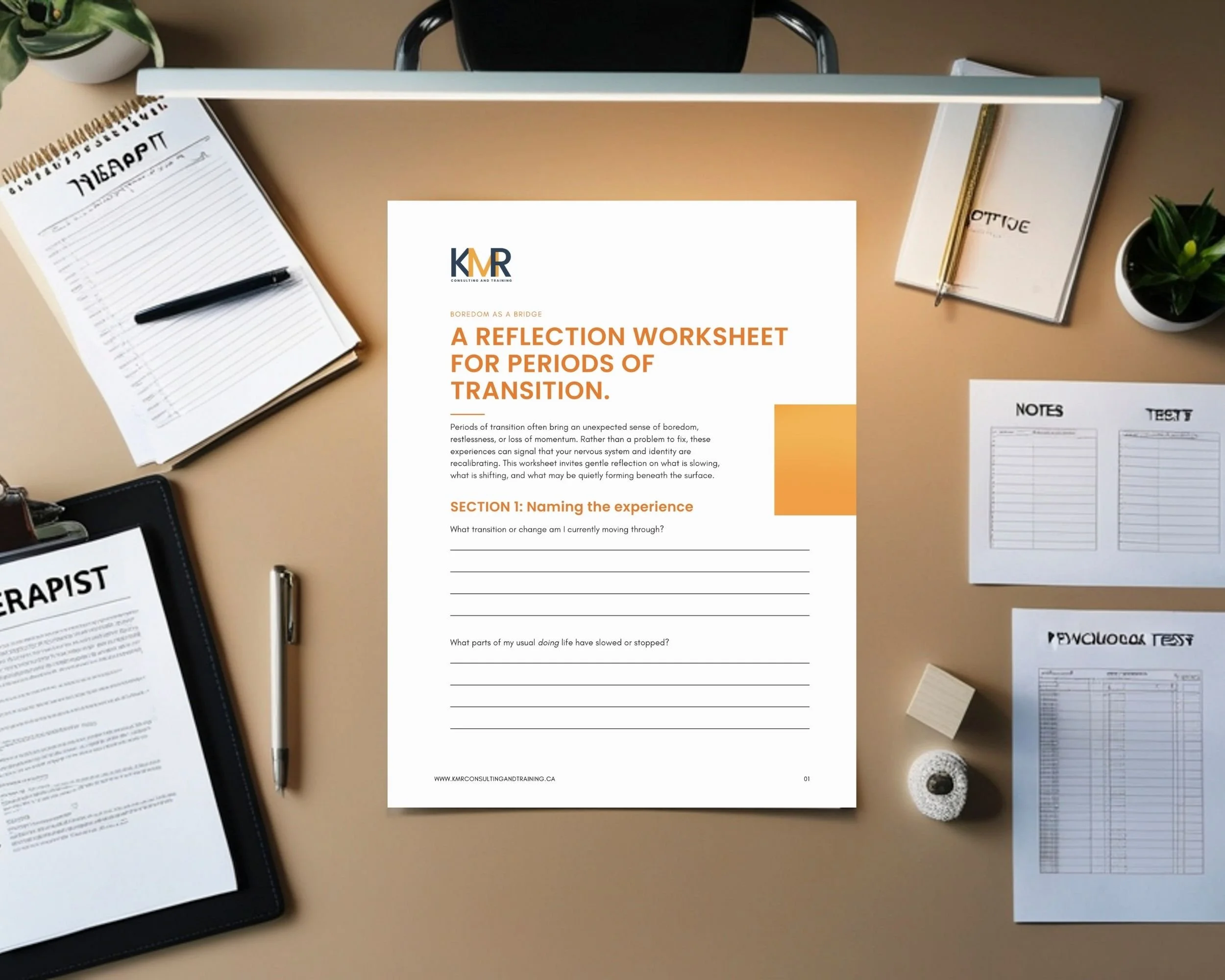
Periods of transition often bring an unexpected sense of boredom, restlessness, or loss of momentum. Rather than a problem to fix, these experiences can signal that your nervous system and identity are recalibrating. This worksheet invites gentle reflection on what is slowing, what is shifting, and what may be quietly forming beneath the surface.